

The Product Marketing Documents Every Company Needs (And How to Actually Use Them)
Most companies don't have a messaging problem. They have a documentation problem.
Ask for the messaging framework and you'll get a blank stare, a link to a dusty Google Doc from 2019, or — my personal favorite — "I think Sarah has something in a folder somewhere."
Meanwhile, sales is rewriting the pitch deck every quarter because they don't trust what marketing gave them. Marketing is rewriting the homepage for the third time this year because nobody can agree on how to describe the product. Leadership describes the company differently on every podcast.

Everyone's winging it. And everyone thinks their version is right.
This isn't a people problem. It's a foundation problem.
Why These Documents Matter
Product marketing isn't just launches and campaigns. It's the foundational documents that align your entire company around how you talk about what you do — and why it matters.
Positioning statements. Messaging frameworks. Feature/benefit matrices. Value propositions by persona.
These aren't bureaucratic exercises. They're the source of truth that makes everything else work.
When these documents exist and are actually used:
Marketing doesn't start from scratch every campaign
Sales references the same value props instead of inventing their own
Customer success sets accurate expectations
Leadership stays on message in public
New hires ramp faster because there's something to learn from
When they don't exist — or exist but collect dust — you get chaos disguised as activity. Lots of content. Lots of campaigns. No consistency. No compound growth.
So why do most companies skip this work?
Because it's not glamorous. It requires hard decisions. It forces alignment conversations that are easier to avoid. It's way more fun to launch a campaign than to sit in a room and argue about positioning.
But here's the thing: every hour you spend on foundational documents saves ten hours downstream. Get them right once, use them forever.
The Four Documents You Actually Need
You don't need a 50-page brand bible. You need four documents that people will actually use.
Document #1: The Positioning Statement
This is your north star. One to two sentences that capture who you're for, what you do, how you're different, and why it matters.
The formula: For [target customer] who [situation/need], [product] is a [category] that [key benefit]. Unlike [alternatives], we [key differentiator].
Weak example: "We help healthcare organizations improve outcomes with innovative technology solutions."
This says nothing. Every competitor can say this.
Strong example: "For multi-location specialty practices drowning in EHR workarounds, [Product] is an operations platform that eliminates manual data entry across sites. Unlike generic practice management tools, we're built specifically for the complexity of multi-site specialty care."
The test: Could your top competitor say this exact thing? If yes, it's not positioning. It's placeholder text.
Document #2: The Messaging Framework
This is your comprehensive guide to how you talk about your product. If the positioning statement is your north star, the messaging framework is the map.
What it includes:
Primary value proposition (the big promise)
3-4 messaging pillars (the key themes you always come back to)
Proof points for each pillar (metrics, case studies, testimonials)
Audience-specific variations (how the message changes by persona)
Competitive differentiation (why you vs. alternatives)
Here's what matters: Keep it to one page.
If your messaging framework is a 30-page document, nobody will use it. The goal isn't to document everything. It's to create a single source of truth that people can actually reference.
Every piece of content should trace back to this page. Every sales deck. Every campaign.
Document #3: The Feature/Benefit Matrix
This is where most companies fail. They list features and stop there.
Your product page says: "Automated data synchronization across locations."
Your buyer is thinking: "So what?"
The feature/benefit matrix forces you to translate what your product DOES into what customers GET.
The structure:
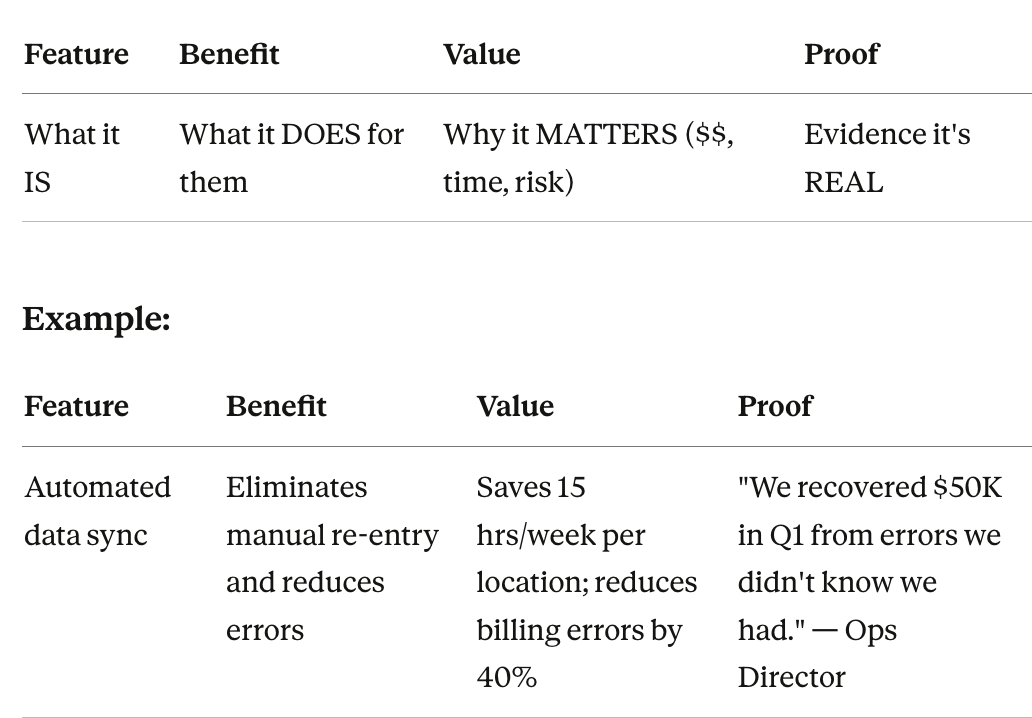
The “So What?” Test:
Read your feature. Ask "So what?" That gives you the benefit. Ask "So what?" again. That gives you the value. Keep asking until you hit business impact.
The "So What?" test: Read your feature. Ask "So what?" That gives you the benefit. Ask "So what?" again. That gives you the value. Keep asking until you hit business impact.
Document #4: Value Propositions by Persona
The CFO doesn't care about the same things as the end user. The operations director has different pain points than the IT lead.
For each persona, document:
Their primary pain point (in their words, not yours)
What success looks like for them specifically
The specific value you deliver to THEM
The proof points that matter to THEM
The objections they'll have and how to address them
One-size-fits-all messaging forces everyone to find themselves in generic language. Persona-specific value propositions make each buyer feel like you're talking directly to them.
The Real Problem: Documents That Collect Dust
Here's the uncomfortable truth I see constantly:
Companies want these documents. They ask for messaging frameworks and positioning statements. They sit through workshops. They get the deliverables.
And then nothing happens. The documents go in a folder. People continue winging it. Sales still rewrites the deck. Marketing still reinvents the wheel.
Why?
Because having the documents feels like progress. The box is checked. "We did the messaging work." But the goal was never to have documents. The goal was to have alignment.
The same thing happens with sales. They ask for battle cards, feature sheets, competitive intel. They want it all. And then they don't read it, don't reference it, don't use it in deals. They just want to know it exists somewhere.
This is documentation as security blanket. Not documentation as operating system.
How to Actually Operationalize These Documents
Creating the documents is step one. Making them part of how your company operates is where the value lives.
Make them findable. If people can't find the documents in under 30 seconds, they won't use them. Pin them in Slack. Link them in your wiki.
Train on them. Don't just share the docs — walk through them. Sales onboarding should include messaging training. New marketers should understand positioning before they write anything.
Reference them constantly. When reviewing content, ask: "Does this align with our messaging pillars?" When prepping for sales calls: "What's the value prop for this persona?" Build the habit of going back to the source.
Make them part of your process. Campaign briefs should reference the messaging framework. Quarterly business reviews should revisit positioning. Build the documents into existing workflows.
Update them. These are living documents. Markets change. Products evolve. Build in quarterly reviews. A messaging framework that's two years old and never updated is a framework nobody trusts.
Hold people accountable. If sales is going off-script, that's a coaching conversation. Having a source of truth only works if people are expected to use it.
The Bottom Line
Your marketing isn't inconsistent because your team is bad at their jobs. It's inconsistent because there's no source of truth to be consistent with.
Build the documents. Operationalize them. Hold people accountable to using them.
That's how messaging becomes a competitive advantage instead of a recurring headache.
